How AI Topography Optimizes the Design of Stepped Buildings on Complex Terrain
Posted 12/22/2025 in Resources
Designing buildings on sloped or uneven terrain has always been a challenge, but with AI applied to topography, the process becomes significantly more efficient in architecture and urban planning.
Proper adaptation of a project to the terrain directly impacts technical feasibility, construction costs, and the overall quality of the built environment. AI topography makes it possible to work with real terrain data from the earliest design stages, generating precise and coherent solutions without the need for time-consuming manual adjustments later on.
Thanks to ARCHITEChTURES, Artificial Intelligence can now be integrated directly into the design workflow, optimizing the placement of terraced buildings on complex sites and preventing issues that are traditionally detected too late in the process.
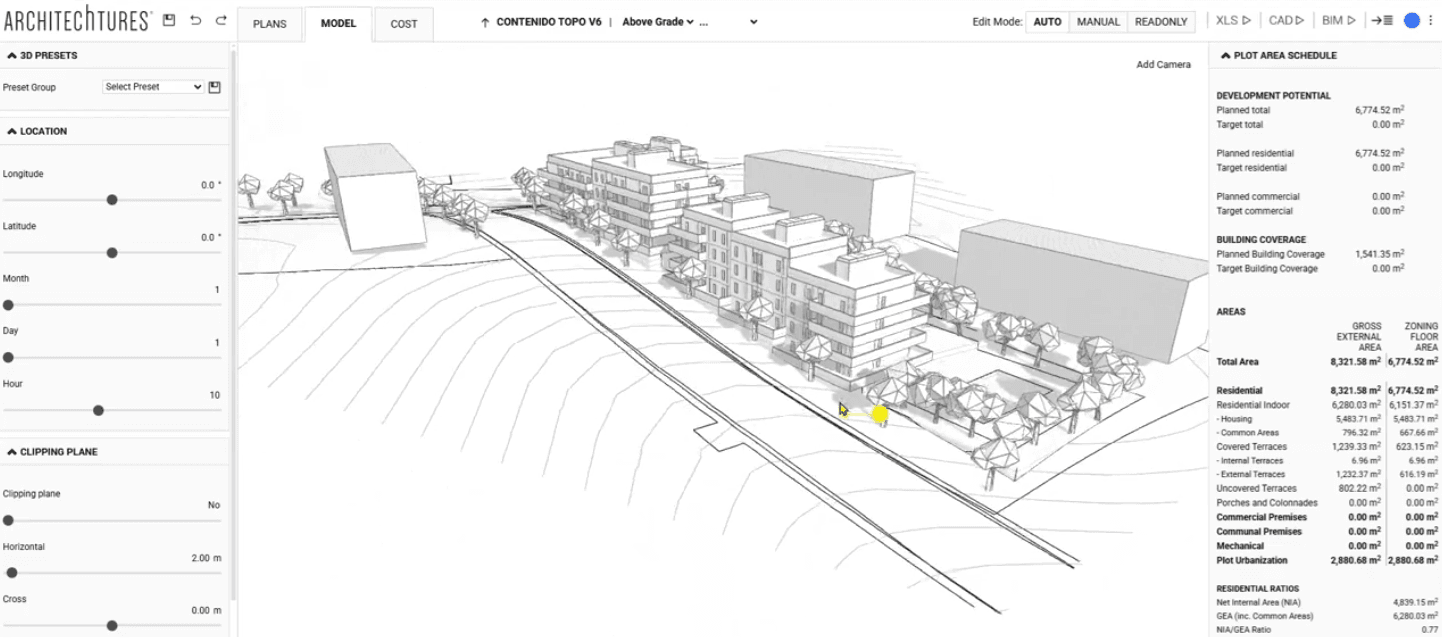
To understand how this works in practice, we will examine the building terracing with platforms functionality within our AI-driven architectural platform. Using AI topography, buildings automatically adjust to terrain elevations from the earliest design phases, generating flat surfaces for construction and access while respecting the natural topography. This approach makes it possible to clearly visualize how the terrain guides building placement and improves both planning accuracy and construction efficiency.
Topography Integration and Automatic Building Terracing
One of the most powerful features of AI topography in ARCHITEChTURES is the automatic terracing of buildings. By directly importing the surrounding context—including plots, streets, existing buildings, and real terrain data—structures can be positioned and stepped instantly, without manual intervention.
This approach allows designers to see in real time how buildings adapt to slopes and elevation changes, ensuring consistency and optimization from the earliest planning stages. It also supports better strategic decision-making, such as defining platform locations and leveled areas, reducing errors and saving valuable development time.
The ability of AI topography to analyze hundreds of elevation points and slopes in seconds makes it possible to simulate multiple design scenarios and select the most effective solution before construction begins. This is especially valuable in projects where every inch of height and every degree of slope affects usability, drainage, and overall performance.
Benefits of AI Topography
The use of AI topography delivers clear and measurable benefits. It improves design accuracy by relying on real terrain data from the outset, reduces discrepancies between design and construction, and helps anticipate potential issues before building begins.
Beyond building terracing, AI topography enables precise definition of platforms and automatic leveling zones. These capabilities are essential when flat surfaces are required for construction, access routes, or shared spaces, while still preserving the site’s natural terrain.
Reference elevations, maximum slopes, and retaining wall heights can be adjusted automatically, ensuring each building integrates harmoniously with its surroundings. This reduces planning errors and allows teams to anticipate earthworks and costs associated with unnecessary grading more efficiently.
It also represents a significant time savings, as processes such as terracing and leveling are handled automatically. Design teams can focus on spatial planning, program efficiency, and urban integration, while AI continuously analyzes the terrain to ensure optimal results.
Another key advantage is simulation and forecasting. Comparative models can be generated for different building layouts, heights, and platform configurations, allowing designers to evaluate terrain impact and optimize decisions before construction begins.
In the following video, we see how ARCHITEChTURES automatically adapts buildings and platforms to the terrain, producing a final result that is coherent, functional, and visually integrated with the landscape. The video clearly shows how terracing and leveling decisions influence the entire project and how topography becomes a central factor in ensuring technical, aesthetic, and long-term viability.
Conclusion: AI Topography as a Driver of Architectural Design
AI topography is transforming the way buildings are designed on complex terrain, enabling precise terracing, seamless adaptation to slopes, and the creation of leveled platforms.
ARCHITEChTURES turns topography into a core design element that guides architectural decisions, optimizing time, resources, and costs while delivering more realistic, functional, and context-responsive outcomes—adding value for designers, clients, and public administrations alike.