How to Increase Real Estate Profitability with AI: +179% with ARCHITEChTURES
Posted 05/19/2026 in Education
Thanks to Artificial Intelligence applied to Architecture, real estate profitability can be optimized from the earliest design stages. Through automated design generation and real-time financial analysis, it becomes possible to compare multiple solutions and select the most profitable option.
In this case study, we will explore how AI made it possible to analyze and optimize different architectural design variants in order to maximize real estate profitability.
1. Automated Architectural Variant Generation with AI
2. Residential Design Optimization and Increased Housing Units
3. BIM Coordination and Underground Parking Design
4. Typology Comparison and Real Estate Profitability Analysis
5. BIM Visualization and Data-Driven Decision Making
1. Automated Architectural Variant Generation with AI
ARCHITEChTURES 360 allows us to compare all project variants created on the platform in a transversal, dynamic, and agile way. Below, we explain how ARCHITEChTURES enabled the analysis of multiple residential building configurations, ultimately achieving a 179% increase in operating profit compared to the original project.
In this example, we are working on a residential building project with planning regulations and constraints already defined in a Partial Plan. After analyzing the site drawings and the overall volumetric organization, we proceed to parameterize the urban planning regulations and the initial target product mix provided by the client.
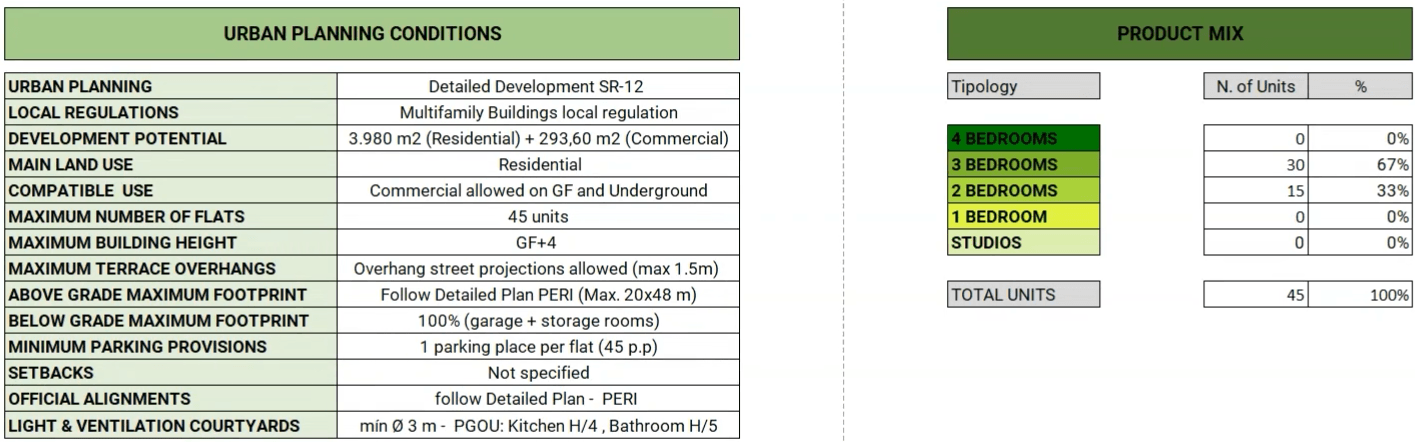
These parameters are introduced into the platform as design objectives, allowing us to generate 30 or 40 different variants while remaining fully compliant with regulations.
2. Residential Design Optimization and Increased Housing Units
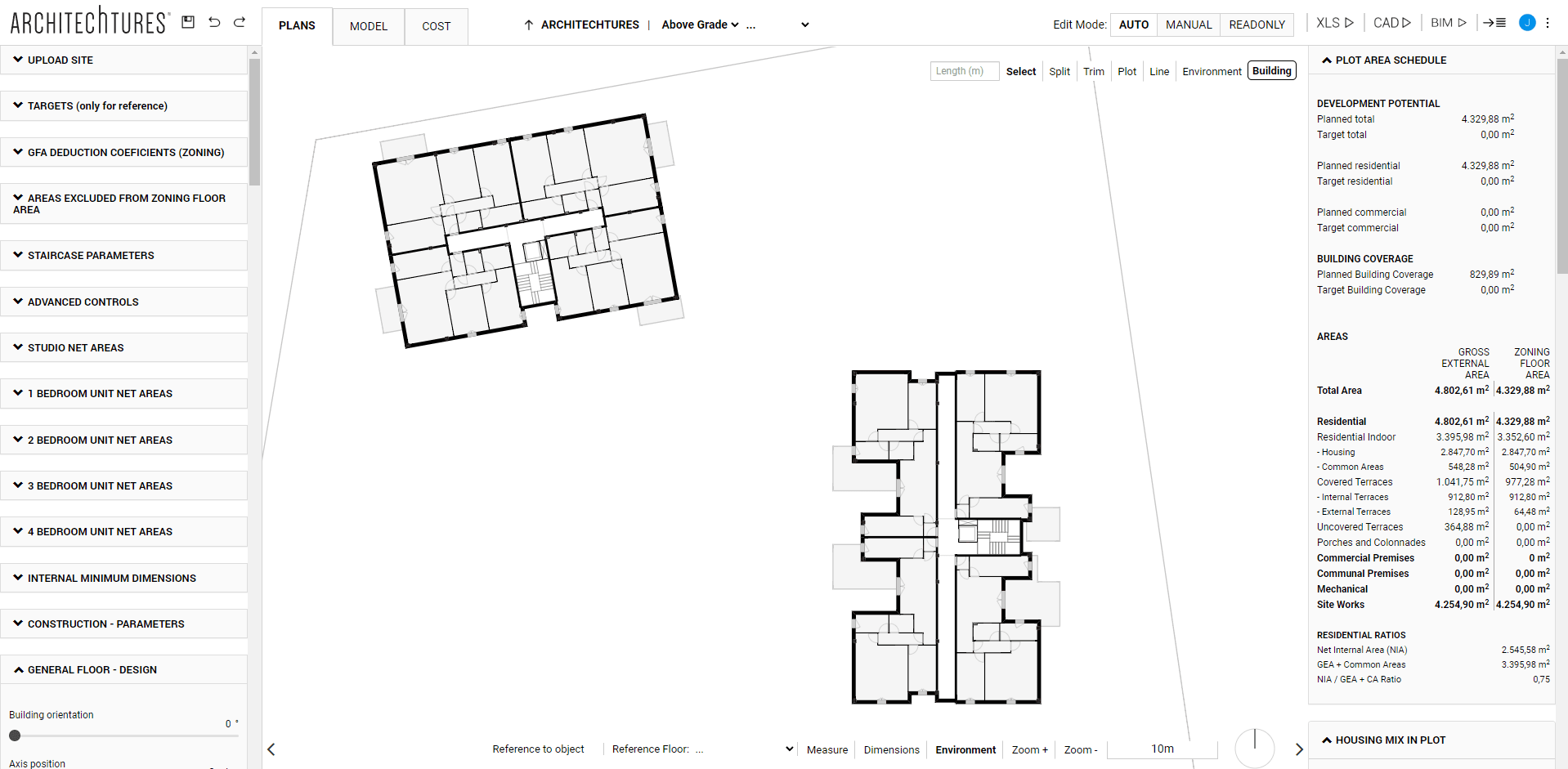
Once inside the editor, we can upload the base plans using a CAD file, including the plot boundary, alignments, urban development, and topography.
In this case, since the plot has a certain slope, we create a platform at the elevation allowed by the Masterplan, taking into account the construction of the parking area with minimal earthworks, in order to optimize its cost.
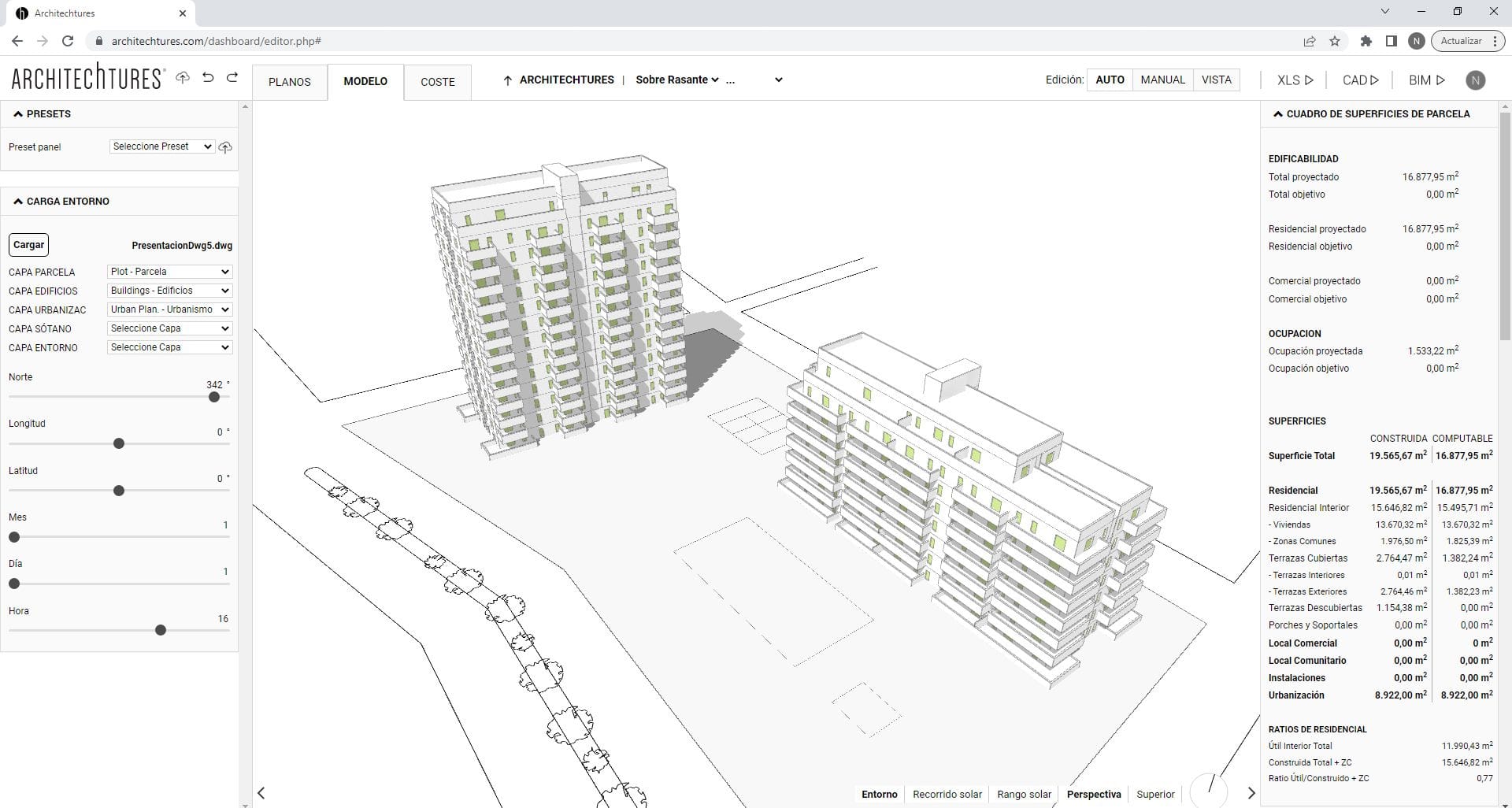
Once the initial targets and design criteria are completed, we proceed to generate the building. For better visualization, we can customize the shading of the different unit types — in this case, the two-bedroom apartments are shown in blue, and the three-bedroom units in red.
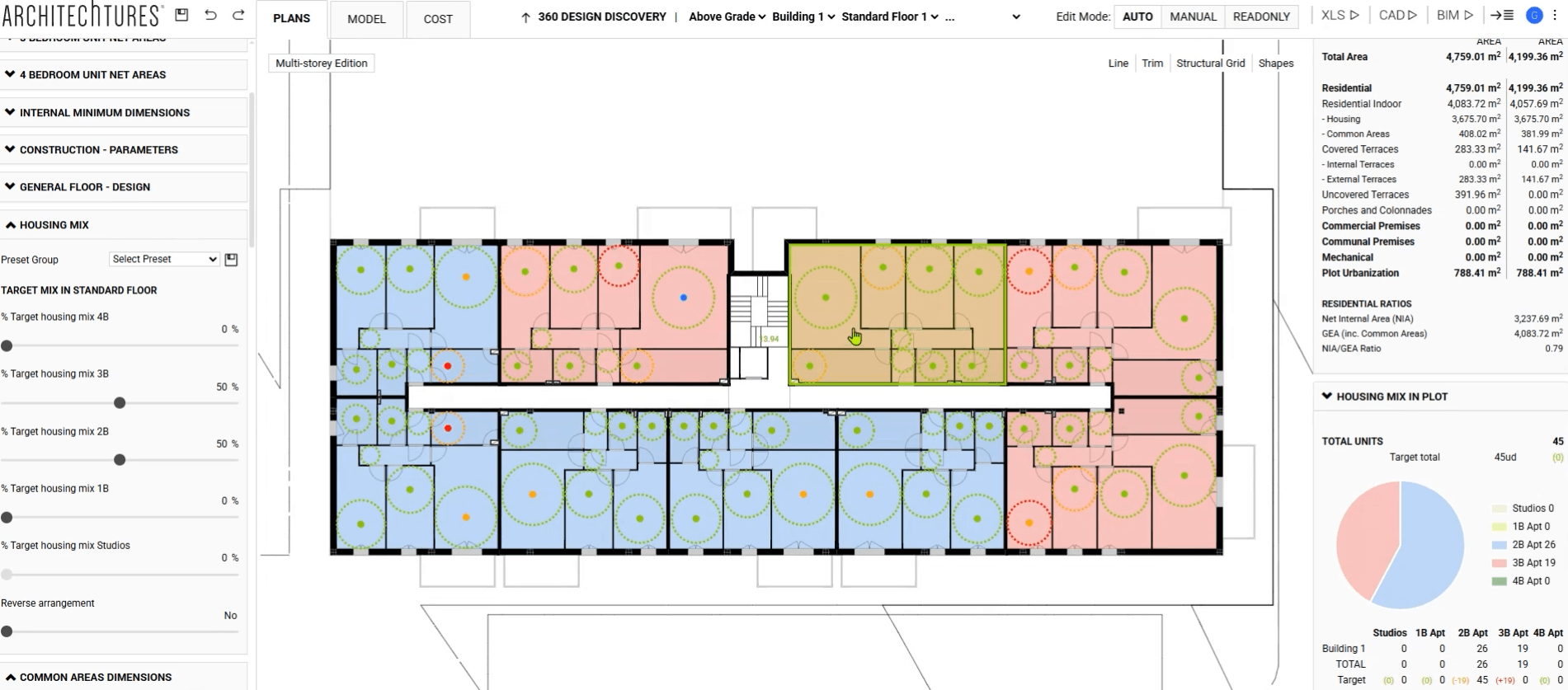
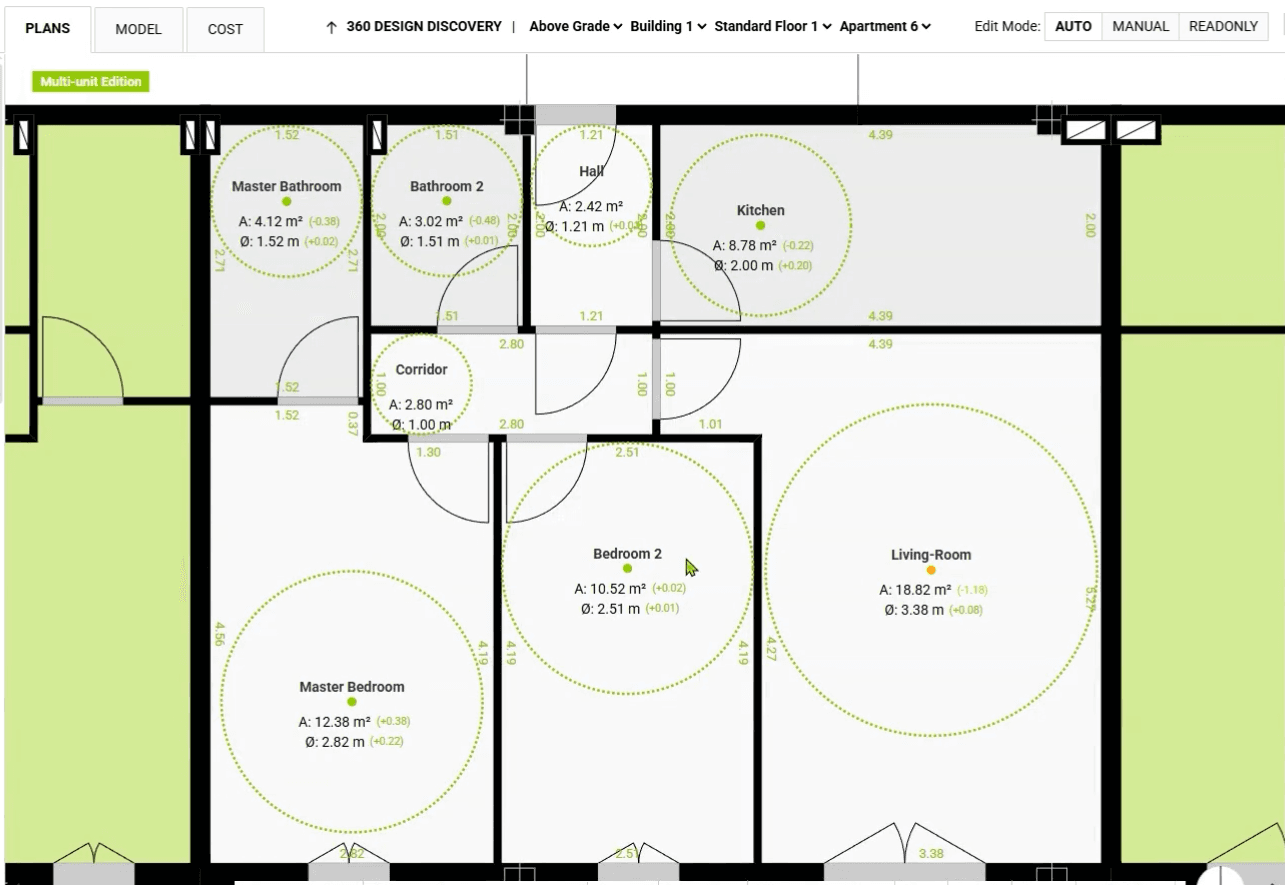
After reviewing the initial results, we observe that the layout of the units can be further optimized by allowing interior kitchens, which significantly reduces the amount of façade required. As a result, we are able to fit one additional unit per floor. Additionally, according to the regulations, we can still build 5 more units. Therefore, we proceed to slightly adjust the product mix through the input panel. By increasing the percentage of two-bedroom units relative to the three-bedroom ones, we manage to fit one additional unit per standard floor, reaching the target of 45 units we had set as our objective.
3. BIM Coordination and Underground Parking Design
With the first building variant completed, we finalized the above-ground design by modeling the communal outdoor areas, including landscaped green zones and trees.
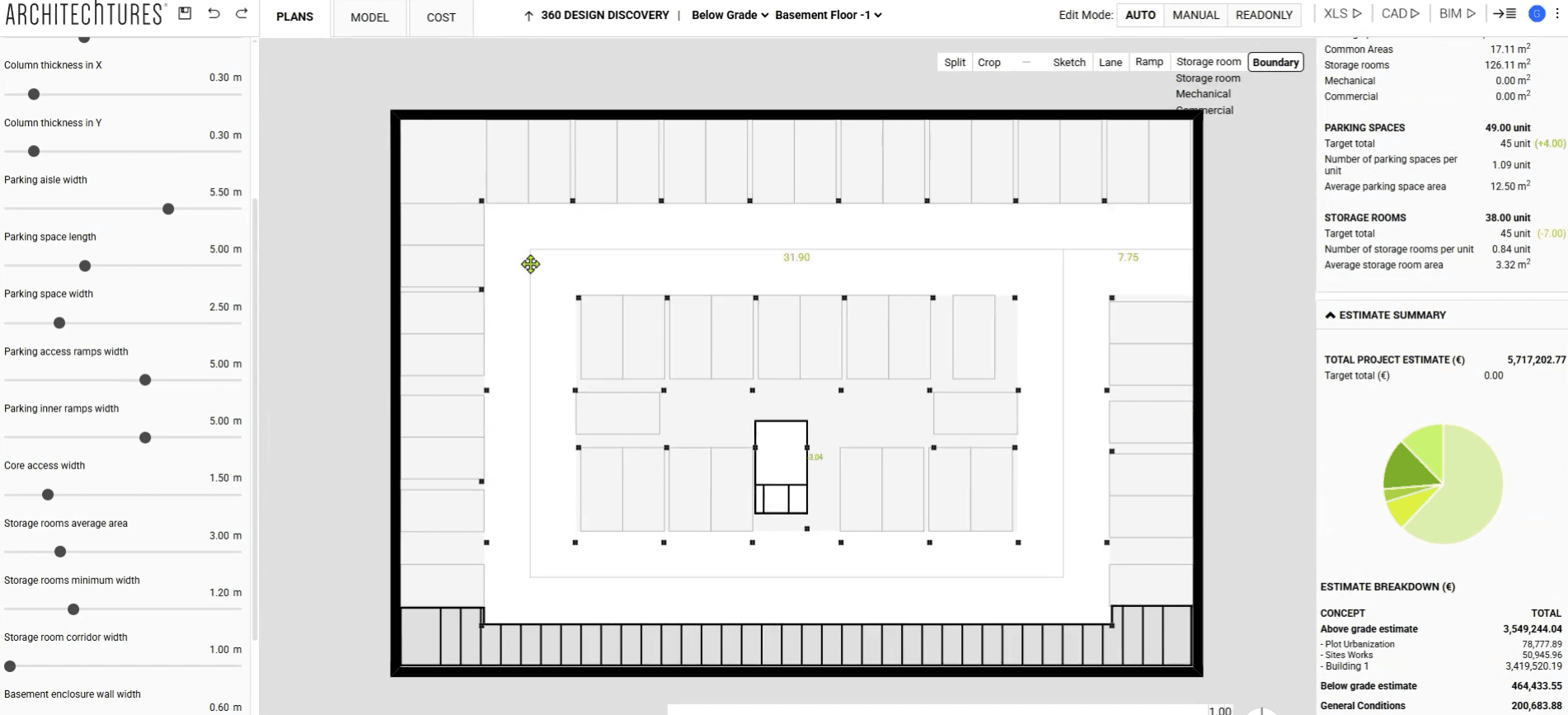
Using the navigation bar located in the central area, we moved on to the underground parking design by defining the basement wall perimeter. The underground model remains perfectly coordinated with the above-ground building at all times, and any modifications made to the structure or circulation cores are automatically updated in real time within the basement model. After verifying compliance with the minimum parking space requirements, we designed the storage room areas, ensuring at least one storage unit per apartment in accordance with regulations and client requirements. Once the project metrics were validated in the data panel, this variant was approved and stored alongside the rest of the project alternatives, which can be generated in unlimited quantities depending on the user’s needs.
4. Typology Comparison and Real Estate Profitability Analysis
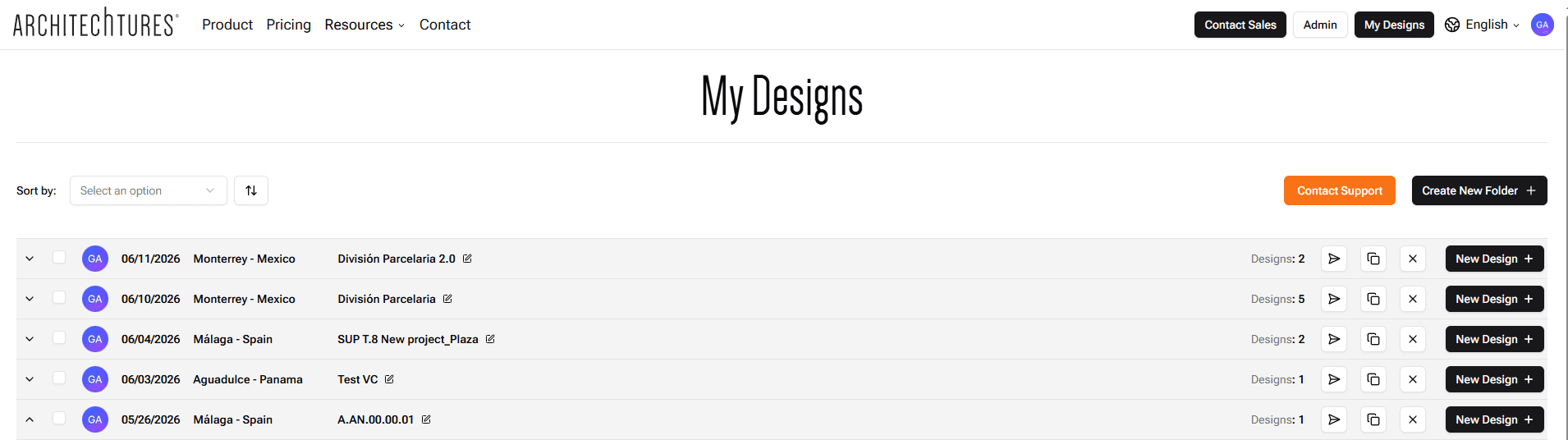
Once the different variants have been resolved, they can be managed from the Project Dashboard. In this project, thanks to the flexibility allowed within the movement area defined by the Partial Plan, we were able to explore three very different building typologies: H-shaped block, Compact block with central corridor and courtyard building with central patio. We can select the variants we want to compare and, by clicking the compare button, access the comparison interface.
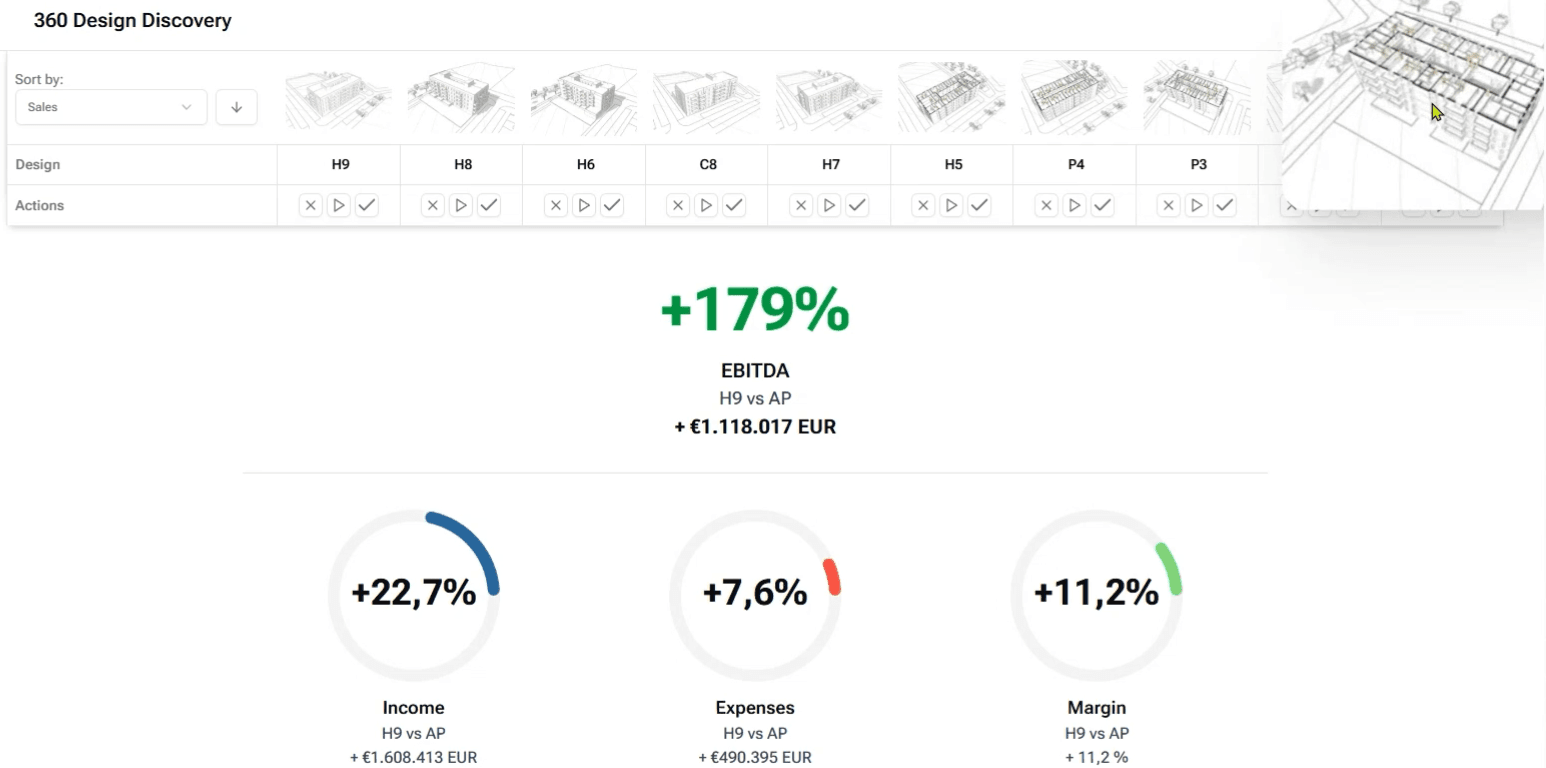
The selected variants are displayed in an organized way in the upper central bar. One of these variants corresponds to the original project designed by the architects and provided by the client, which we included to perform a fully data-driven comparison.

In the left-side panel, we can explore different metrics displayed in the central charts, including:
. Buildable area and building footprint.
. Product mix achieved.
. Average apartment sizes.
. Underground floor areas.
. Construction budget.
. Pricing by housing typology.
. Sales projections.
. Sales margins for each variant.
The variants can be sorted according to any desired criteria, such as target areas, total residential area, above-ground construction costs, or EBITDA. In this case, all versions showed similar total floor areas. However, there were enormous differences in profit margins. Sales projections are also generated scientifically, since they are not based solely on price per square meter. Instead, the system evaluates all parameters that affect residential pricing, including:
. Floor height.
. Natural lighting and orientation.
. Ventilation quality.
. Penalties for deviation from the target product mix.
As shown in the summary chart, variant H9 outperformed the architects’ original project by more than €1 million in EBITDA, while the original design turned out to be the least profitable among the 10 analyzed variants.
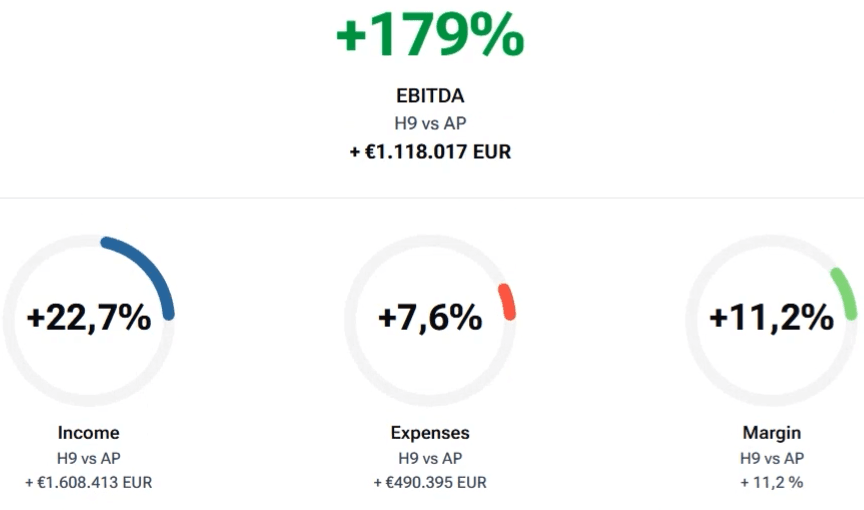
This resulted in a 179% increase in operating profit achieved by exploring all these alternatives and using ARCHITEChTURES to optimize the project to the maximum extent possible.
5. BIM Visualization and Data-Driven Decision Making
By clicking the play button on any variant, we can access the BIM model of the project and navigate through it using both 3D views and floor plans. All project data can also be reviewed in the panel located on the right-hand side. Additionally, users can navigate through the financial module to review detailed budget chapters, including model-based quantities and associated costs, as well as other financial aspects of the project. Excel files, CAD files, and BIM models for each variant can also be downloaded directly from the buttons located in the upper-right toolbar.
As demonstrated, 360 Design Discovery is extremely easy to use and enables users to make project decisions based on real-time data and measurable results.
The combination of artificial intelligence, generative design, and financial analysis makes it possible to significantly improve real estate profitability from the earliest stages of a project. Tools such as ARCHITEChTURES enable developers and architects to explore data-driven architectural alternatives, helping them make faster, smarter, and more profitable decisions.