Artificial Intelligence and Architects: Allies or Rivals?
Posted 02/26/2026 in Resources

The emergence of AI for architects is quietly transforming the way architecture firms work. What just a few years ago seemed like a futuristic promise is now part of everyday professional practice.
For an architect, it’s not just that AI can ‘create renders’; what’s truly interesting is that it’s starting to ‘think’ about early design decisions—what fits, what complies, what maximizes value, and what works… all before a team has even opened Revit.
This shift ranges from the automatic generation of design proposals to assisted regulatory analysis, surface optimization, and early-stage energy simulations. But this evolution raises an inevitable question: is AI for architects a strategic tool or a professional threat?
Beyond sensationalism, the relationship between Artificial Intelligence and Architecture is not a competition between humans and machines. Rather, it is a redefinition of the professional role in a context where speed, data, and efficiency have become key factors.
The key factor is that when the ‘good’ iteration—the optimized one—can be produced very quickly, it changes the standard. What used to be ‘a good proposal’ now becomes ‘the best out of 500.’ And that pressure isn’t imposed by AI… it’s imposed by the client. Their main concern is finding the very best option, the one that maximizes their return. AI enables and amplifies this shift in the standard between what’s acceptable and what’s outstanding.
At ARCHITEChTURES, we believe the relationship between Artificial Intelligence and architects is best understood by exploring the reasons why this technology is more of an ally than a rival:
1- What AI in Architecture really means
2- Practical case study: AI in architectural practice
. Multifamily housing competition with high regulatory complexity
. Profitability optimization in real estate development
. Sustainability and energy efficiency in residential blocks
3- The critical question: can AI replace the architect?
4- How the professional profile is changing
5- Real risks and limitations
6- Is AI the Future of Architecture?
1- What AI in Architecture really means
When we talk about AI for architects, we are not referring solely to generating attractive images or automatic renders. The concept encompasses a set of technologies capable of assisting in decision-making, automating complex processes, and expanding analytical capacity in the early stages of a project.
AI doesn’t just speed up tasks; it changes the workflow. Options and metrics come first; then come intention, judgment, and architectural language. In practice, AI for architects enables:
Processing large volumes of urban data. From zoning parameters to sunlight exposure, density, site coverage, or buildable area, AI can analyze multiple variables simultaneously and detect constraints or opportunities that would take hours to review manually.
Generating design alternatives based on parameters. Through generative systems, it is possible to define criteria — minimum area, number of units, orientation, setbacks, efficiency — and obtain multiple optimized configurations that meet those conditions from the outset.
Optimizing residential layouts. AI for architects makes it possible to evaluate interior layouts according to objective metrics: circulation efficiency, percentage of usable area, façade-to-depth ratio, or building compactness. This is especially relevant in multifamily housing and real estate developments.
Analyzing regulatory compliance. One of the biggest challenges in multifamily housing projects is integrating zoning regulations, habitability conditions, and technical requirements. AI can automatically verify whether a proposal meets key parameters before moving forward to later phases.
Simulating energy performance. In early stages, AI facilitates preliminary estimates of energy consumption, optimal orientation, cross-ventilation, or solar exposure, helping to make decisions that directly impact sustainability and future costs.
Automating repetitive tasks. From generating similar unit types to adjusting geometric parameters, automation frees up the architect’s time to focus on strategy, creativity, and higher-value decision-making.
Ultimately, Artificial Intelligence does not replace professional judgment; it amplifies analytical capacity, accelerates processes, and enables the exploration of scenarios that were previously unfeasible due to time or resource constraints.
2- Practical case study: AI in architectural practice
To better understand its impact, let’s look at how Artificial Intelligence is applied in real projects:
Multifamily housing competition with high regulatory complexity
Imagine an urban lot intended for 80 housing units, with multiple constraints: mandatory setbacks, maximum 70% site coverage, height limits, cross-ventilation requirements, and a minimum usable area ratio.
Traditionally, an architecture firm had to generate volumetric alternatives, adjust circulation cores, recalculate areas, and verify compliance with regulations iteratively—a process that could take days. If your competition uses AI, they can iterate 50 times more. You’re no longer just competing on quality… you’re competing on speed of exploration, on providing the confidence that every option has been considered, and on delivering the best solution backed by data.
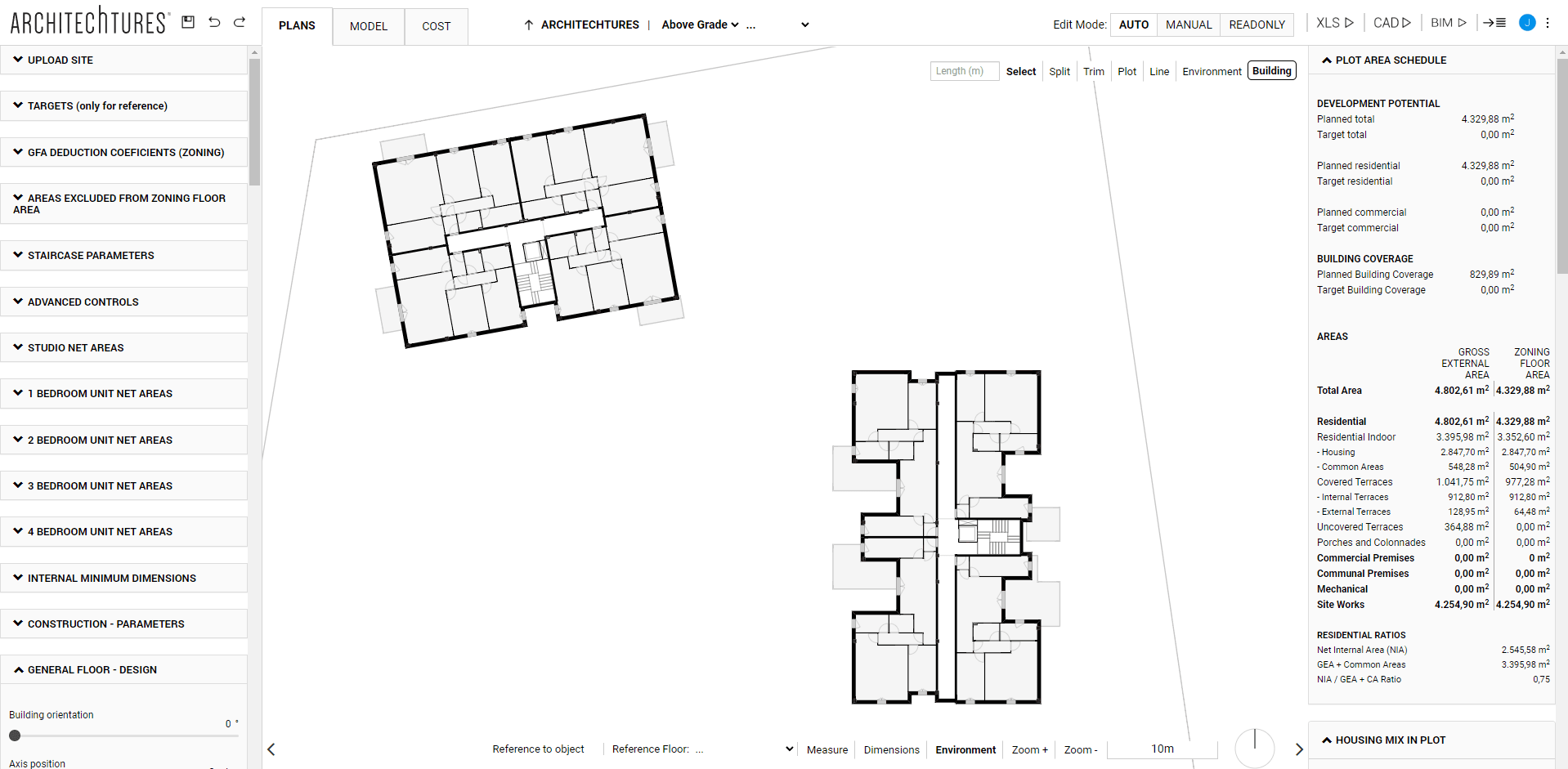
Today, thanks to AI, it is possible to automatically generate multiple configurations, filter out proposals that do not comply with regulations, analyze the efficiency of each alternative, compare usable area ratios, and evaluate unit types in real time. The architect does not disappear: the role shifts from manually producing each alternative to strategically evaluating the generated options. In this context, AI acts as a capacity multiplier and enables more informed decisions from the earliest stages.
Profitability optimization in real estate development
In residential projects, small design decisions can have a direct impact on economic feasibility. For example, increasing usable area by just one square meter per unit in a 40-unit development can make a significant difference in final results.
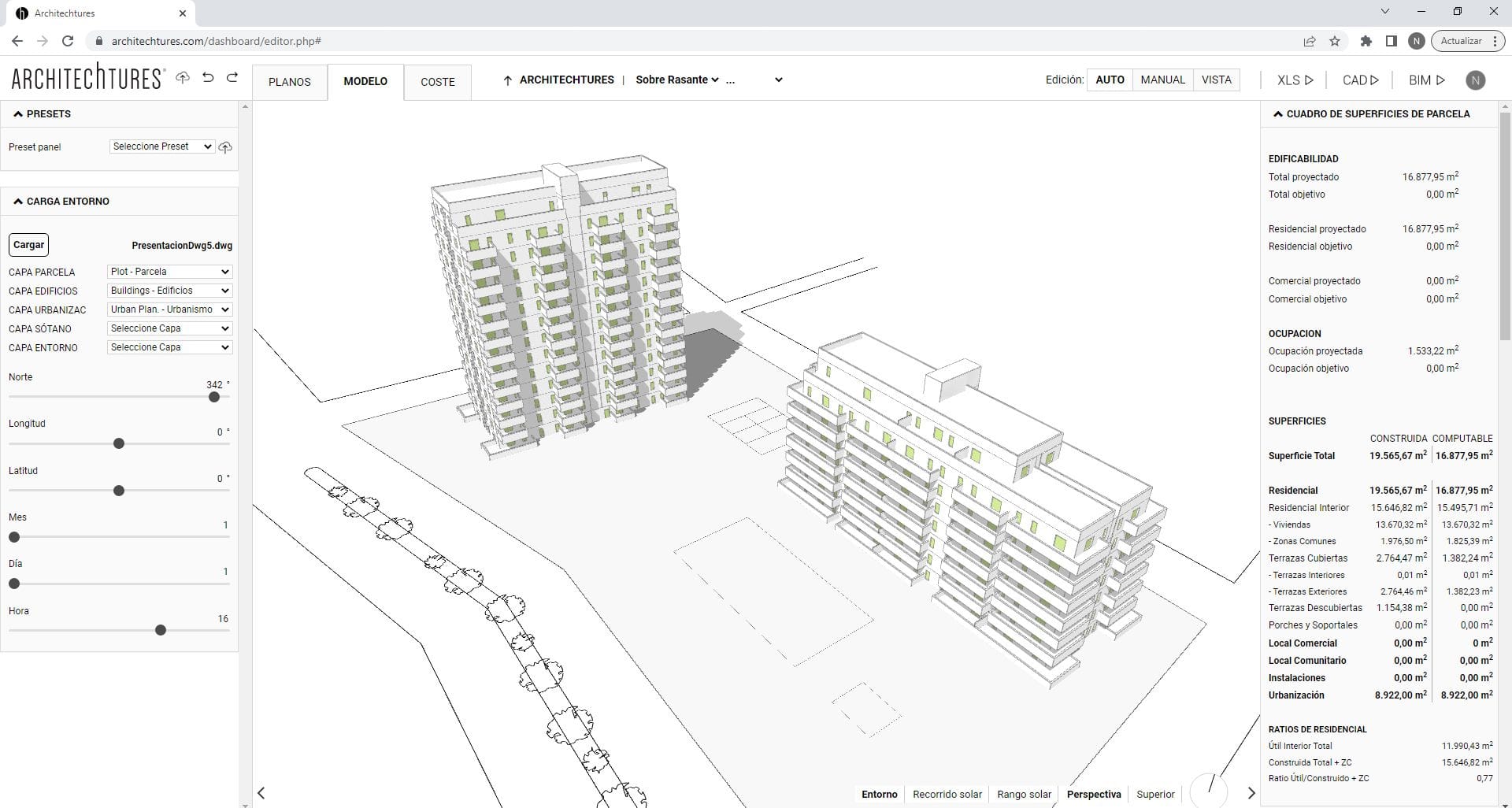
AI for architects makes it possible to analyze thousands of layout combinations, maximize usable area without violating regulations, optimize circulation and cores, and adjust unit types according to market demand. Thanks to tools like ARCHITEChTURES, firms can identify more efficient and strategic solutions that would hardly emerge in a time-constrained manual process. Technology does not replace the architect’s vision, but it improves the quality of decisions.
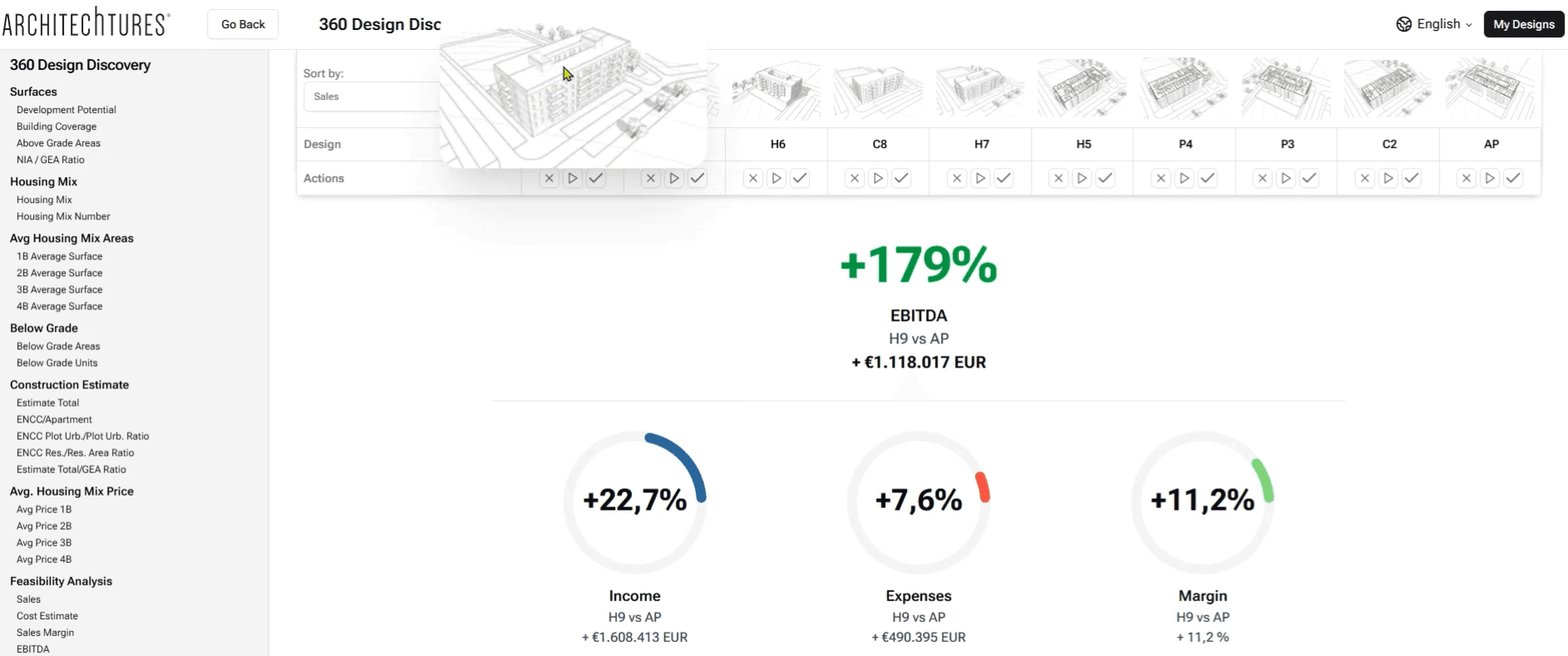
Example of EBITDA differences across multiple variants generated with ARCHITEChTURES’ AI (building type, unit mix) for a simple real estate development.
Sustainability and energy efficiency in residential blocks
Another area where AI provides tangible value is predictive simulation. From conceptual stages, systems can evaluate optimal building orientation, analyze solar exposure, simulate energy demand, and compare different envelope solutions.
Small adjustments — such as rotating a block to reduce cooling demand, adjusting a unit’s depth to enhance cross-ventilation, or balancing the percentage of openings to optimize daylight and energy consumption — become informed decisions thanks to AI. It is not about the machine designing a sustainable building on its own, but about equipping the architect with objective information to support every choice.
If you want to dive deeper, our blog features other articles showing practical applications of our tool. For example, how to apply AI for topography with ARCHITEChTURES, parking design, how to combine BIM + AI in the workflow, or a case study of a preliminary architectural design developed in Madrid, Spain.
3- The critical question: can AI replace the architect?
It is the uncomfortable question that arises when discussing Artificial Intelligence in Architecture. The tools have proven to be powerful, but their scope has clear limits:
What AI can do:
- Generate floor plans and basic configurations: it allows rapid production of layout alternatives that would otherwise take hours or days manually.
- Optimize layouts: it helps organize building spaces efficiently, evaluating how different areas connect, the proportion between usable and common spaces, and the relationship between units.
- Produce multiple alternatives: it offers a wide range of options for the architect to select and refine.
- Analyze massive datasets: it compares ratios, areas, energy consumption, and other indicators in seconds.
What AI can’t do (yet):
- Interpret cultural context: it cannot understand the history of a place, the identity of a neighborhood or city, or the symbolic values a project should reflect. For example, it does not know which architectural elements respect local tradition, how to integrate cultural references, or how a design can engage with its historical and social environment — decisions only an experienced and sensitive architect can make.
- Understand social impact: AI cannot anticipate how a building will influence the lives of its inhabitants or the dynamics of the urban environment. For example, it does not know whether a plaza will encourage community interaction, whether a block will affect neighbors’ privacy, or how a project will change the user experience of a neighborhood; these decisions require human judgment and social awareness.
- Assume ethical responsibility: it does not make decisions about safety, well-being, or professional matters involving human judgment. It does not assess evacuation risks, accessibility for people with reduced mobility, or prioritize user health and comfort; all of these depend on the architect’s experience and responsibility.
- Build spatial narrative: it cannot determine how a space “tells a story” or how it should feel when experienced. For example, it does not perceive whether a corridor conveys openness and brightness, or whether a living room generates warmth and connection; these aspects depend on the architect’s judgment and sensitivity.
Architecture is not only about solving technical constraints: it is about interpreting place, understanding users, and projecting identity. AI responds to parameters; the architect defines which ones matter and how to balance them, combining creativity, judgment, and experience.
Ultimately, Artificial Intelligence can multiply options, accelerate processes, and improve decision-making, but only an architect can decide what deserves to become Architecture.
AI proposes. The architect responds (and signs off).
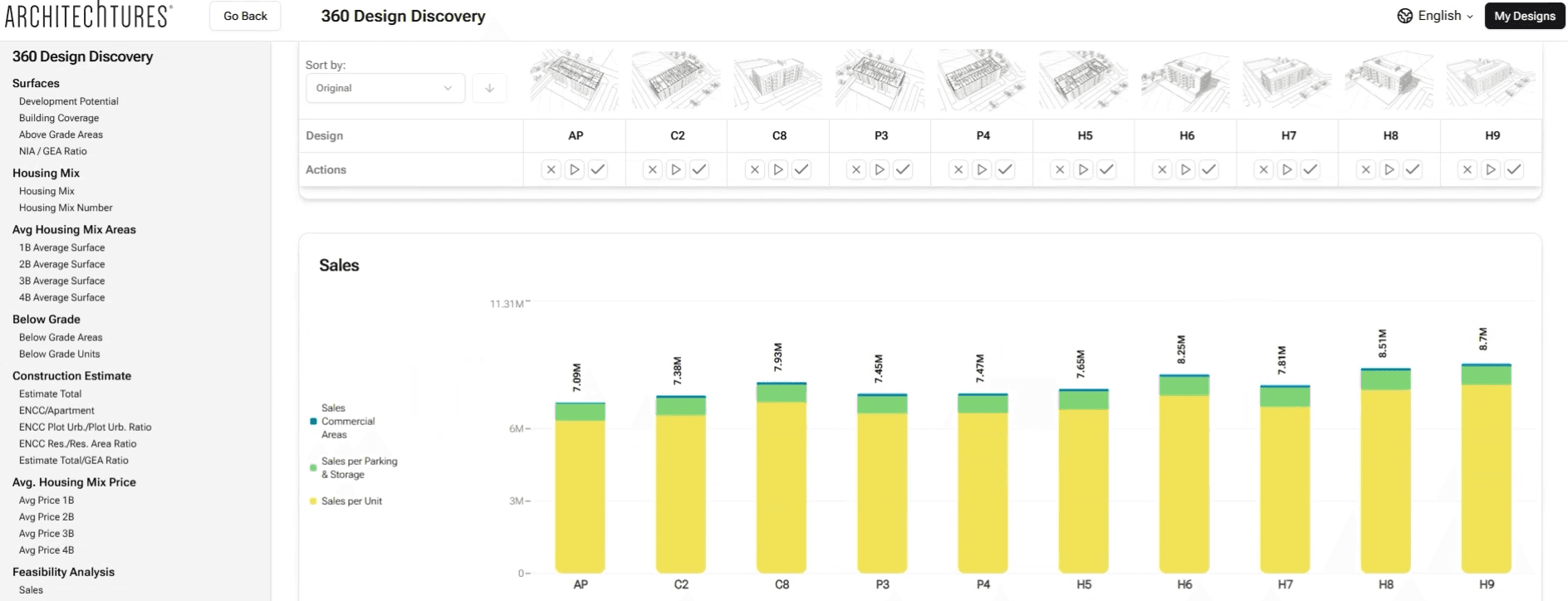
Example of how to evaluate the most profitable designs with ARCHITEChTURES.
4- How the professional profile is changing
The expansion of AI for architects is generating new profiles:
- Architects specialized in generative processes.
- Professionals focused on data analysis.
- Hybrid designers bridging technology and design.
Learning to integrate AI into the workflow not only expands an architect’s capabilities but also opens up new career opportunities and specializations in an increasingly competitive market. It’s not that AI replaces the architect—it’s that the market is beginning to compare architects with AI to those without it.
5- Real risks and limitations
The debate is not naive. There are risks that every professional must consider.
Design homogenization: If everyone uses the same algorithms with the same parameters, results may tend toward similar solutions. Human creativity remains essential to break patterns.
Excessive dependence: Using Artificial Intelligence without understanding its logic can create technological dependency. Architects must maintain their own professional judgment.
Transformation of the job market: Some junior tasks may be automated. This may alter internal learning dynamics within firms. However, new specializations are also emerging.
The limit of AI is responsibility: Just because a design created with AI is optimal and code-compliant doesn’t mean it doesn’t require human verification—and let’s not forget that the responsibility still lies with the person signing off on the project, that is, the architect.
6- Is AI the Future of Architecture
Some may see the relationship between Artificial Intelligence and Architecture as an opportunity for collaboration, while others may view it as a battle.
Undoubtedly, AI is here to stay. It has become part of dozens of professions, not only making work more efficient but also improving its quality. We firmly believe it will become part of the daily routine for AEC professionals, and especially in areas like multifamily housing design—where layout optimization and regulatory compliance are highly complex—it will become a must-have in the industry. For an architect, ignoring it may no longer be a smart professional choice.
The real future belongs to those who know how to combine creativity, professional judgment, and technology. AI can generate thousands of alternatives, speed up processes, and analyze complex data—but only the architect can decide which options make sense and which truly add value to the project.
The real question may not be whether Artificial Intelligence can replace the architect… but rather which parts of the work will continue to be done by humans and which will become commoditized.